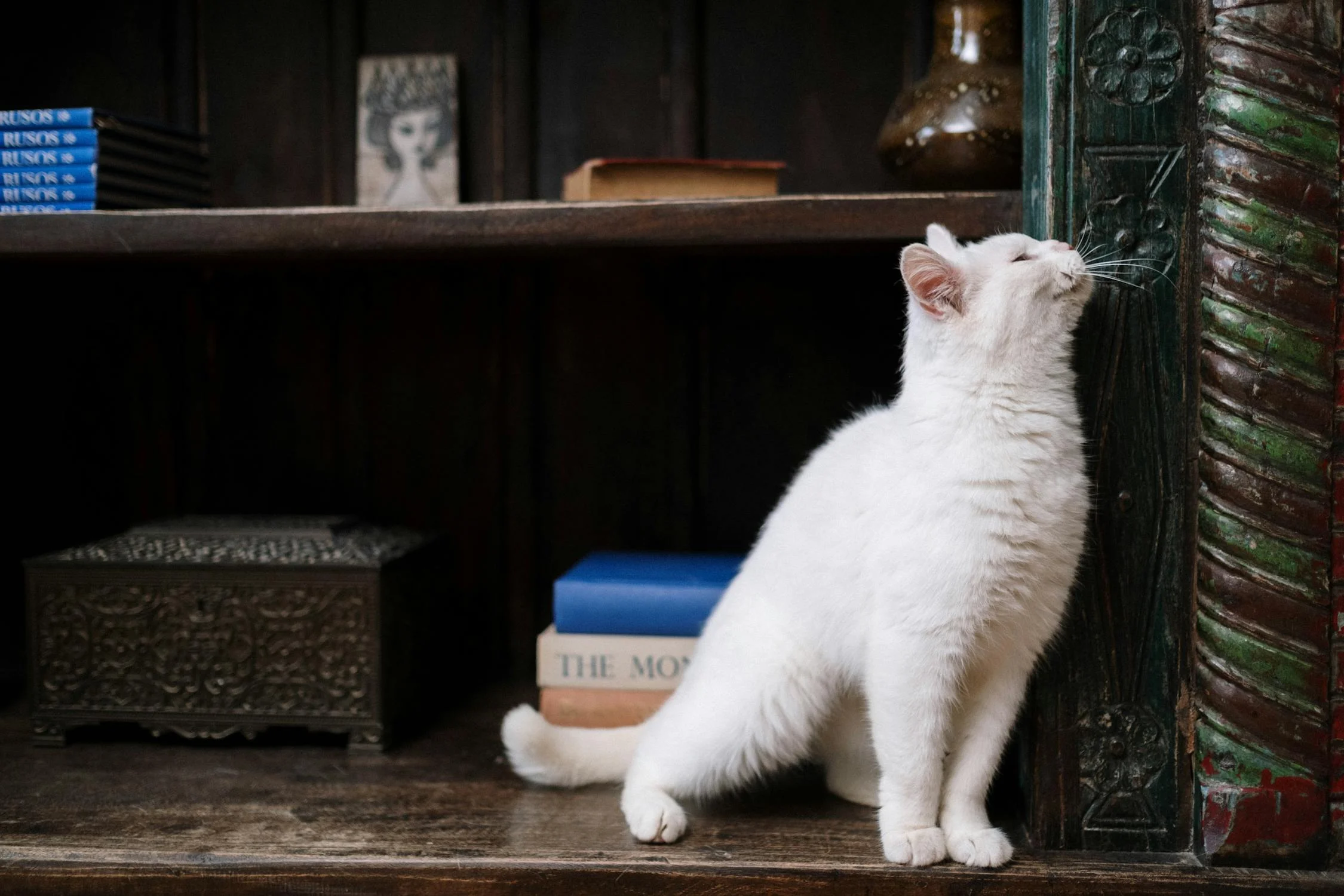
One of the most important ways cats share information with each other—and even with humans—is through scent. Unlike humans, who rely primarily on verbal and visual cues, cats use scent as a fundamental part of their social interactions. A cat’s sense of smell is far more powerful, with many times more scent-detecting cells in its nose than we have. This heightened ability allows them to detect and interpret an incredible range of odours, making scent one of their primary means of communication. In addition to their noses, cats have a secondary scent organ called the vomeronasal organ (VNO), or Jacobson’s organ, located in the roof of their mouth. This organ allows them to detect pheromones—chemicals secreted in different areas of the body by all cats for communication within the species.
Ways Cats Use Scent to Communicate
1. Marking Territory
Cats are highly territorial animals, and scent marking is one of the primary ways they establish boundaries. They have scent glands located in multiple areas, including their cheeks, forehead, paws, flanks, and the base of their tail. When a cat rubs its face against furniture, doorways, or even people, it deposits pheromones that signal ownership and familiarity. Scratching leaves scent marks, too. This type of marking reassures the cat that its environment is safe and helps other cats recognise established territories.
Cats also mark their territory through urine and faeces, which leave both odour and pheromone deposits. Unlike typical urination, which is done in a squatting position, spraying is performed while the cat stands upright, often with a quivering tail. The scent left behind provides critical information about the cat’s identity and reproductive availability. Cats usually bury their faeces, although some leave them uncovered, particularly further from home; whether this is a deliberate territorial message is still debated.

2. Social Bonding and Recognition
Skin is used for chemical communication too, particularly through the odours and pheromones that are produced by sebaceous and sweat glands. Cats that live together often develop a communal scent, which helps them recognise and bond with each other. This is why cats that are close companions will frequently rub against one another or engage in mutual grooming. This behaviour, known as allogrooming, helps reinforce social bonds and spread familiar scents among a group.
When a cat rubs against a human, it is marking them as part of its social group and doing the same as they would in greeting another cat by mutual rubbing of the face and body. When your cat rubs around your legs to greet you, they are doing the same as they would in greeting another cat by mutual rubbing of the face and body. Afterwards, your cat will take themself off to groom and check out your scent. Similarly, cats will often rub against objects in their ‘home’ area, depositing their scent. Cats rubbing their heads against objects is known as ‘bunting’. Bunting often happens in the core area of their territory and seems to be associated with comfort, reassurance and friendly social interactions. If your cat frequently head-bumps you, it is transferring its scent to you, which is often a good sign that the cat sees you as an affiliate member of its social group.

3. Signalling Mating Readiness
Scent plays a crucial role in feline reproduction. Female cats (queens) in heat release powerful pheromones through their urine and from glands in their body. These pheromones signal their reproductive status to potential mates. Male cats (toms) can detect these pheromones from a significant distance and will often respond by vocalising, searching for the female, or spraying their own scent to stake their claim. A cat will open his VNO for in-depth analysis. You can tell when the cat is in the process of this because he will have his mouth partially open in what is referred to as the flehmen grimace or flehmen reaction. Males typically engage in this behaviour when he comes across the urine of females in heat, but all cats will use their VNO whenever they come across a scent requiring more investigation.
Male cats also use scent to assess the competition. When encountering another male’s scent marks, a tom can determine whether the rival is a potential threat. This may help males avoid unnecessary fights.

4. Warning Other Cats and Expressing Stress
Cats also use scent to communicate distress or fear. In stressful situations, such as visiting the vet or encountering an unfamiliar cat, it is thought that a frightened cat may release alarm pheromones that warn other cats of danger, although this has not been firmly demonstrated. If your cat suddenly starts spraying indoors or marking excessively, it may be a sign of stress, anxiety or territorial insecurity – but ask your vet to rule out medical causes first.


5. Identifying Each Other and Recognizing Kin
Cats rely heavily on scent to recognise familiar individuals. Within days of birth, kittens learn their mother’s scent and use it as a source of comfort and security.
In multi-cat households, scent recognition is critical for maintaining harmony. When a new cat is introduced, the existing cats may react negatively because the newcomer lacks the familiar scent of the household. Gradual introductions, including scent-swapping techniques (and pairing these scents with positive experiences), can help ease the transition and prevent conflicts.
How to Use Scent to Strengthen Your Bond with Your Cat
Understanding how cats use scent can help you improve your relationship. Here are some practical tips:
- Respect their scent markings: Avoid cleaning areas where your cat frequently rubs its face, as this removes its familiar scent and may cause stress. When cleaning urine, use scent-free cleaning supplies.
- Allow scent exchange: If you have multiple cats, encourage scent swapping by pairing up a cloth containing the scent of another cat with food rewards or fun play. Place the cloth on the floor a couple of metres from your cat, and reward them or play with them after they sniff it. So long as individual cats respond positively to the other cat’s scent, you can start to encourage cats to rub their cheeks on the cloths containing the scent of others, to create a mixed scent profile.
If you’re experiencing issues with your cats not getting on or you’re unsure how to introduce cats in your home, please get in touch for expert advice.
- Introduce new scents gradually: If bringing a new pet, person, or piece of furniture into the home, allow your cat time to acclimate by introducing the scent gradually.
- Use synthetic pheromones: Products like Feliway mimic natural feline pheromones and may help some anxious cats feel more secure as part of a wider plan, although the evidence for them is mixed.
- Scratching posts: Offer both horizontal and vertical scratching surfaces that are long enough for your cat to fully stretch on. Consider different substrates to find your cat’s preference, and you can entice them to scratch with incentives such as toys and treats.

Conclusion
Cats have an intricate and sophisticated way of communicating through scent. From marking their territory to reinforcing social bonds and signalling mating readiness, their olfactory messages shape much of their behaviour. By understanding and respecting this form of communication, cat owners can create a more comfortable and harmonious environment for their feline companions. The next time your cat rubs against you or scratches a surface, remember—it’s not just random behaviour; it’s a deliberate and meaningful form of feline communication.
If you experience any concerns with your cat’s behaviour, such as your cat toileting indoors, scratching furniture, or if you’re unsure how to introduce cats in your home, get in touch with us to see how we can help.

References
- Bradshaw, J. W. S. (2016). Sociality in cats: A comparative review. Journal of Veterinary Behavior, 11, 113–124. https://doi.org/10.1016/j.jveb.2015.09.004
- Cisneros, A., Litwin, D., Niel, L., & Stellato, A. C. (2022). Unwanted scratching behavior in cats: Influence of management strategies and cat and owner characteristics. Animals, 12(19), Article 2551. https://doi.org/10.3390/ani12192551
- DePorter, T. L., Bledsoe, D. L., Beck, A., & Ollivier, E. (2019). Evaluation of the efficacy of an appeasing pheromone diffuser product vs placebo for management of feline aggression in multi-cat households: A pilot study. Journal of Feline Medicine and Surgery, 21(4), 293–305. https://doi.org/10.1177/1098612X18774437
- Elzerman, A. L., DePorter, T. L., Beck, A., & Collin, J.-F. (2020). Conflict and affiliative behavior frequency between cats in multi-cat households: A survey-based study. Journal of Feline Medicine and Surgery, 22(8), 705–717. https://doi.org/10.1177/1098612X19877988
- Feldman, H. N. (1994). Methods of scent marking in the domestic cat. Canadian Journal of Zoology, 72(6), 1093–1099. https://doi.org/10.1139/z94-147
- Frank, D., Beauchamp, G., & Palestrini, C. (2010). Systematic review of the use of pheromones for treatment of undesirable behavior in cats and dogs. Journal of the American Veterinary Medical Association, 236(12), 1308–1316. https://doi.org/10.2460/javma.236.12.1308
- Hart, B. L., & Leedy, M. G. (1987). Stimulus and hormonal determinants of flehmen behavior in cats. Hormones and Behavior, 21(1), 44–52. https://doi.org/10.1016/0018-506X(87)90029-8
- Horwitz, D. F. (2019). Common feline problem behaviors: Urine spraying. Journal of Feline Medicine and Surgery, 21(3), 209–219. https://doi.org/10.1177/1098612X19831203
- Levine, E., Perry, P., Scarlett, J., & Houpt, K. A. (2005). Intercat aggression in households following the introduction of a new cat. Applied Animal Behaviour Science, 90(3–4), 325–336. https://doi.org/10.1016/j.applanim.2004.07.006
- Natoli, E. (1985). Behavioural responses of urban feral cats to different types of urine marks. Behaviour, 94(3–4), 234–243. https://doi.org/10.1163/156853985X00208
- Pryor, P. A., Hart, B. L., Bain, M. J., & Cliff, K. D. (2001). Causes of urine marking in cats and effects of environmental management on frequency of marking. Journal of the American Veterinary Medical Association, 219(12), 1709–1713. https://doi.org/10.2460/javma.2001.219.1709
- Raihani, G., González, D., Arteaga, L., & Hudson, R. (2009). Olfactory guidance of nipple attachment and suckling in kittens of the domestic cat: Inborn and learned responses. Developmental Psychobiology, 51(8), 662–671. https://doi.org/10.1002/dev.20401
- Ramos, D. (2019). Common feline problem behaviors: Aggression in multi-cat households. Journal of Feline Medicine and Surgery, 21(3), 221–233. https://doi.org/10.1177/1098612X19831204
- Verberne, G. (1976). Chemocommunication among domestic cats, mediated by the olfactory and vomeronasal senses: II. The relation between the function of Jacobson’s organ (vomeronasal organ) and flehmen behaviour. Zeitschrift für Tierpsychologie, 42(2), 113–128. https://doi.org/10.1111/j.1439-0310.1976.tb00960.x
- Verberne, G., & de Boer, J. (1976). Chemocommunication among domestic cats, mediated by the olfactory and vomeronasal senses: I. Chemocommunication. Zeitschrift für Tierpsychologie, 42(1), 86–109.
- Vitale Shreve, K. R., & Udell, M. A. R. (2017). Stress, security, and scent: The influence of chemical signals on the social lives of domestic cats and implications for applied settings. Applied Animal Behaviour Science, 187, 69–76. https://doi.org/10.1016/j.applanim.2016.11.011
- Wilson, C., Bain, M., DePorter, T., Beck, A., Grassi, V., & Landsberg, G. (2016). Owner observations regarding cat scratching behavior: An internet-based survey. Journal of Feline Medicine and Surgery, 18(10), 791–797. https://doi.org/10.1177/1098612X15594414
- Zhang, L., & McGlone, J. J. (2020). Scratcher preferences of adult in-home cats and effects of olfactory supplements on cat scratching. Applied Animal Behaviour Science, 227, Article 104997. https://doi.org/10.1016/j.applanim.2020.104997